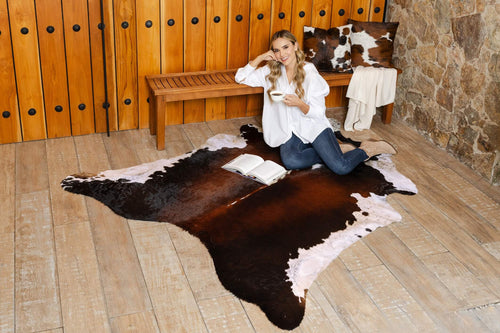
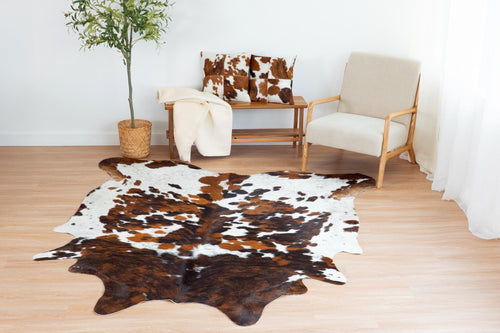
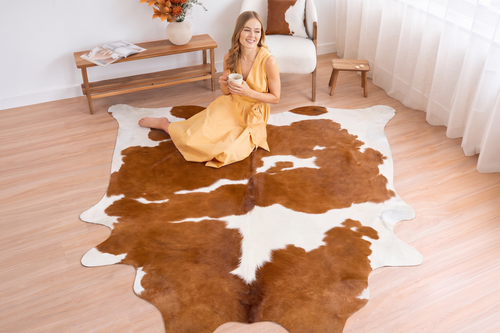
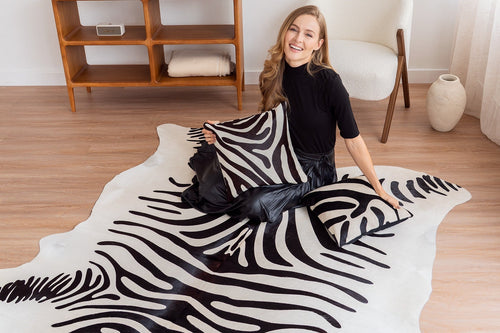
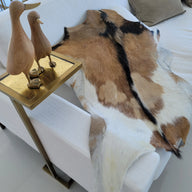
There's a category of home goods that looks better the more you know about it. Where the production story adds to the object rather than complicating it. A Patchwork Cowhide Rug is one of those things. The geometric grid. The hand-stitched seams. The Brazilian artisan tradition behind every piece. The zero-waste philosophy that makes it one of the most defensible floor covering purchases available from a sustainability standpoint.
Most people discover patchwork cowhide visually — they see it in a room and want to know what it is. This guide answers that question completely, and gives you everything you need to choose, style, and own one confidently.
What Is a Patchwork Cowhide Rug — and How Is It Made?

A patchwork cowhide rug is made by hand-selecting premium sections of genuine Brazilian cowhide, cutting them to consistent dimensions, and hand-sewing them together into a geometric grid pattern — most commonly a checkerboard of squares. Every section is real hair-on-hide cowhide. Every seam is stitched by hand. Every finished piece is unique.
All patchwork cowhide rugs at eCowhides are handmade in Brazil — sourced from the same premium Brazilian cattle that produce the core natural hide collection, processed by the same LWG-certified tanneries, and assembled by skilled Brazilian artisans with generations of leather craft tradition. The combination of premium raw material and genuine artisan construction is what separates eCowhides patchwork from the mass-produced imitations that flood the broader market.
The construction process in detail:
- Selection. Premium hide sections are hand-selected for quality, consistent hair coverage, and compatible coloring within the intended pattern. This selection step — matching sections that will sit adjacent in the finished grid — is where most of the artisan judgment lives.
- Cutting. Each section is cut to precise, consistent dimensions so the grid reads cleanly across the full rug. Irregular cutting is the most common quality failure in lower-end patchwork — it makes the geometric structure look uneven from a standing distance.
- Sewing. Sections are hand-sewn at the seams with tight, consistent stitching. In a quality patchwork rug, the seams are nearly invisible from standing height — what reads is the pattern, not the construction. The stitching must also be structurally sound enough to hold for 20+ years of use, which requires skill and proper technique rather than speed.
- Finishing. The completed rug is trimmed, the hair surface is lightly brushed for consistency, and the piece is inspected before listing.
The result is a rug that combines the authenticity and natural character of genuine Brazilian Cowhide with a visual structure — the geometric grid — that no single natural hide can produce on its own.
"Patchwork cowhide rewards close inspection in a way most floor coverings don't. From across the room it reads as a bold geometric. Up close, every square is a different piece of natural hide — different markings, different hair direction, different tonal variation. That combination of visual order and material complexity is what makes it so compelling." — Maria Santos, Principal Designer, Santos Interiors, San Antonio TX
Which Pattern Belongs in Your Room

At eCowhides, patchwork rugs come in two primary colorways — tricolor and brindle. They share the same construction and the same sizes, but create meaningfully different visual effects. The choice comes down entirely to your room's color temperature.
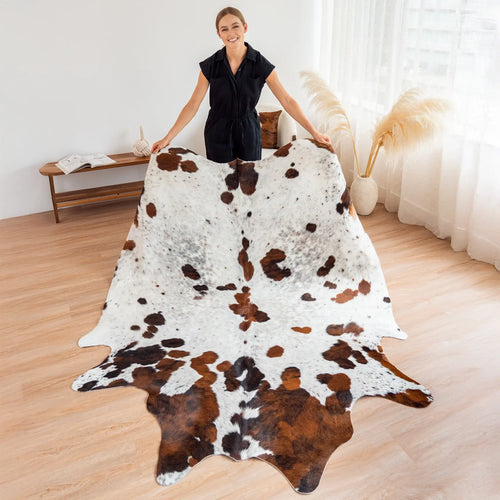
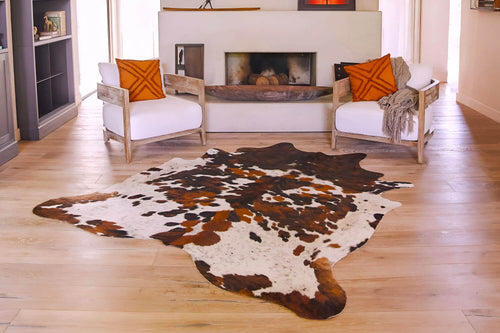
Tricolor Patchwork: Each square is cut from Tricolor Cowhide — the natural three-tone spotted pattern of dark brown, warm caramel, and ivory. In a patchwork grid, the adjacent squares carry different distributions of the same three tones, creating a warm, rich checkerboard where the eye reads both the geometric structure and the organic variation within it simultaneously. It's the patchwork for rooms with warm wall tones — cream, terracotta, sage green, warm greige — and furniture in walnut, oak, leather, or warm linen.
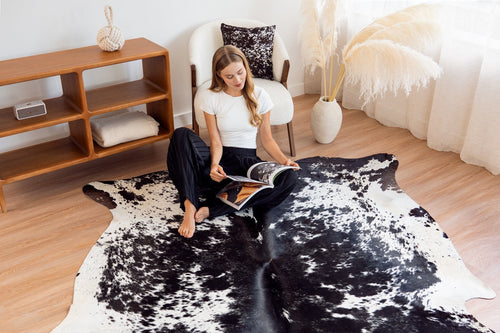
Brindle Patchwork: Each square is cut from Brindle Cowhide — the streaked dark brown, tan, and cool grey pattern. The directional streaking of brindle means adjacent squares often run in different directions, creating a subtle texture variation within the geometric grid that makes the rug more visually complex than a flat checkerboard. The grey tones in brindle give it wider room compatibility — it works in both warm and cool environments — making it the more versatile of the two options.
Type |
Tone Range |
Best Room Style |
Wall Color Match |
Tricolor Patchwork |
Warm brown + caramel + ivory |
Farmhouse, bohemian, eclectic, transitional |
Off-white, cream, terracotta, sage green |
Brindle Patchwork |
Dark brown + tan + cool grey |
Transitional, contemporary, modern farmhouse |
Warm white, grey, navy, charcoal |
The Rug Color Guide at Chris Loves Julia is the most practical palette-matching reference for confirming which colorway fits your specific room and wall color.
Where Patchwork Cowhide Works Best — and the One Room Where It Steals the Show

Patchwork cowhide is versatile. It works across living rooms, dining rooms, entryways, bedrooms, and home offices. But there's one context where it does something nothing else does quite as well.
Living Rooms: The most natural placement. A patchwork hide anchoring a seating area creates a warm, geometric focal point with enough visual complexity to be the room's primary design element — without competing with the furniture or art. Front legs of all major seating pieces sit on the rug. Emily Henderson's Rug Size Guide and the Cowhide Placement 101 Guide cover sizing logic for every room format.
Dining Rooms: Patchwork under a dining table frames the table and chairs with a geometric floor plane that makes the whole room feel designed. The non-porous hide surface handles dinner party spills without drama. Keep at least 24 inches of hide extending beyond the table on each side for pulled-out chairs.
The one room where it steals the show: open-plan living and dining spaces. In a combined living-dining area — the most common layout in contemporary home design — a large patchwork hide anchoring the living zone does something a natural-shaped hide can't: its structured, consistent edges define the seating area within the open floor plan with visual clarity. In an open plan, the patchwork grid is both a design statement and a spatial tool. An 8x10 or 9x12 patchwork anchoring the seating zone in a large open-plan space is one of the most satisfying floor coverage decisions available.
Sizes available at eCowhides:
- 4x6 ft — dining rooms, compact living areas, entryways
- 5x8 ft — standard living rooms, mid-sized dining rooms
- 8x10 ft — larger living rooms, open-plan zones, primary suites
- 9x12 ft — large living rooms, formal dining rooms, open-plan anchors
- 10x14 ft — grand living spaces, great rooms, large open plans
- Custom sizing — available for non-standard dimensions
This size range — from compact 4x6 pieces to grand 10x14 statement rugs — is the widest available for genuine handmade patchwork cowhide. Most competitors offer two or three standard sizes. eCowhides' Brazilian artisan partners can produce any format the space requires.
"Patchwork cowhide in an open-plan space is a spatial tool as much as a design choice — the geometric grid defines zones and anchors furniture arrangements in a way that naturally shaped hides simply can't. In a great room or combined living-dining space, it's the single most effective floor covering I know how to specify." — Jerome Whitfield, Senior Interior Designer, Whitfield + Co., Chicago IL
How to Style a Patchwork Rug With Pillows & Natural Accents

A patchwork rug on the floor is strong. The full room story comes from connecting it to other elements — at different heights and in different formats — within the same material language.
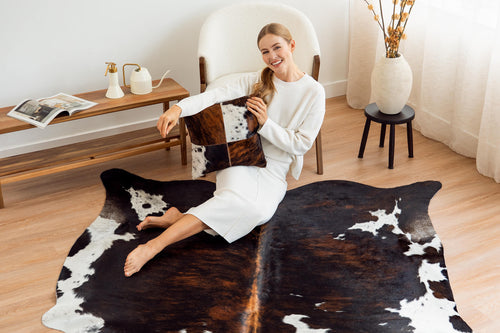
Patchwork Pillows on the sofa: The most direct complement. A Patchwork Cowhide Pillow on the sofa repeats the geometric construction at a different scale and plane. The repetition is what makes a room read as intentional. For the sofa grouping, the Set of Three — one patchwork pillow plus two classic natural hides in a complementary colorway — creates a layered combination that works better than a matched set.
Natural hide pillows as contrast: A Tricolor Cowhide Pillow or Brindle Cowhide Pillow alongside a patchwork rug creates a complementary relationship between the geometric construction and the organic natural pattern. The contrast is exactly what makes it interesting. Available in 15x15, 20x20, and 12x20 lumbar. Backing options: Cowhide Backing for maximum texture, Fabric Backing for softer sofa placement, Leather Backing for a tailored finish.
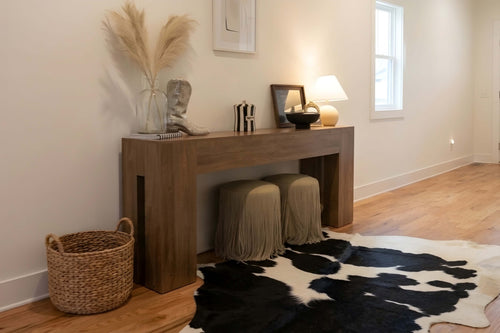
Natural accents: Patchwork cowhide reads best alongside other natural materials — warm wood furniture, rattan, linen, woven baskets, ceramic. The geometric structure of the patchwork provides visual order; the surrounding natural materials provide warmth and organic texture. The combination of order and warmth is what makes a room feel collected rather than decorated. The Decorate a Room Guide walks through building from the rug outward.
Rug layering: A patchwork hide works well as a top layer over a larger natural fiber base — jute, sisal, or seagrass. The geometric structure reads clearly against the rough organic texture of the base, and the layering creates visual depth that anchors the seating area further into the room. BHG's How to Layer Rugs and 5 Tips for Layering Rugs cover the mechanics.
Runners in adjacent zones: A natural-pattern Cowhide Runner in an adjacent hallway extends the hide material story from the main room without doubling the patchwork. The natural organic pattern in the hallway and the geometric patchwork in the main room create variety within the same material family.
The Zero-Waste Story Behind Every Patchwork Hide — and Why It Matters

Patchwork cowhide carries a sustainability story that most luxury floor coverings can't claim. Every piece begins as a Byproduct of the Meat Industry — the animal is raised for food, not for its hide. Patchwork construction takes that principle one step further: every premium section of hide is hand-selected and used with intention, so that nothing of quality is wasted in the production process. The result is a rug where the material has been respected at every stage — from Brazilian ranch to certified tannery to artisan workshop.
This matters beyond the individual purchase. The Environmental Impact of Discarded Materials research makes clear the cost of production models that waste what's valuable. Patchwork cowhide is the opposite model: premium material, used fully, crafted by hand into something that lasts for decades. That's not a sustainability workaround. It's a premium production philosophy.
For buyers making considered purchases — choosing materials that reflect values as well as aesthetics — the patchwork story is worth knowing. The Cowhide Sustainability practices eCowhides documents and the Ethical Sourcing post cover the complete picture.
"Patchwork cowhide is the circular economy applied to floor coverings — premium material, used fully, crafted by skilled Brazilian hands into something that lasts for decades. That's not a talking point. It's the production reality, and it results in a genuinely beautiful product." — Priya Menon, Sustainability Researcher & Interior Consultant, Portland OR
FAQ: Patchwork Cowhide Edition

What Is A Patchwork Cowhide Rug?
A Patchwork Cowhide Rug is made by hand-sewing carefully selected premium sections of genuine Brazilian cowhide into a geometric grid pattern. Every section is real hair-on-hide cowhide. Every seam is stitched by hand. The result combines natural material authenticity with a visual structure no single hide can produce.
Where Are eCowhides Patchwork Rugs Made?
All patchwork cowhide rugs at eCowhides are handmade in Brazil by skilled artisans using genuine Brazilian Cowhide from LWG-certified tanneries. The Brazilian artisan tradition in leather craft produces the consistent seam quality and section matching that separates quality patchwork from mass-produced alternatives.
What Sizes Do Patchwork Cowhide Rugs Come In?
eCowhides patchwork rugs are available in 4x6, 5x8, 8x10, 9x12, and 10x14 ft — the widest size range available for genuine handmade patchwork cowhide. Custom sizing is also available for non-standard dimensions. This range covers everything from compact dining room anchors to grand living room statement pieces.
What Is The Difference Between Tricolor And Brindle Patchwork?
Tricolor patchwork uses squares from tricolor hide — warm dark brown, caramel, and ivory — creating a warm, rich geometric that works best in warm-toned rooms. Brindle patchwork uses squares from brindle hide — dark brown, tan, and cool grey — creating a cooler, more contemporary grid with wider room compatibility. Same construction, same sizes, different color temperature.
Can A Patchwork Cowhide Rug Be Customized?
Yes — custom sizing is available at eCowhides for non-standard dimensions. Contact the eCowhides team directly to discuss custom patchwork specifications. Standard sizes (4x6, 5x8, 8x10, 9x12, 10x14) are available immediately from current inventory.
Where Does Patchwork Cowhide Work Best?
Living rooms, dining rooms, and especially open-plan living-dining spaces where the geometric grid defines zones visually. The patchwork's structured edges create spatial clarity in open-plan rooms that naturally shaped hides can't achieve. It also performs beautifully in entryways and primary suites at the right size.
How Do I Style A Patchwork Cowhide Rug With Pillows?
The most effective combination: a Patchwork Cowhide Pillow plus one or two natural single-pattern pillows (Tricolor or Brindle). The geometric patchwork and the organic natural pattern contrast in a way that's more interesting than matching sets.
What Is The Zero-Waste Story Behind Patchwork Cowhide?
Every piece begins as a byproduct of the food industry — the animal is raised for food, not for its hide. Patchwork construction means every premium section of that hide is hand-selected and used with intention, so nothing of quality is wasted. Premium material, used fully, crafted by hand. That's the production philosophy behind every piece.
How Long Does A Patchwork Cowhide Rug Last?
20+ years with basic care — the same as a full natural hide. The hand-sewn seams in a quality patchwork are built to hold for the life of the piece. Weekly shake-outs, prompt blotting of spills, and occasional spot cleaning are all the maintenance required. Full care instructions are in the eCowhides Cleaning and Care Guide.
How Do I Clean A Patchwork Cowhide Rug?
Shake it out weekly. Blot spills immediately with a dry cloth — never rub. Spot clean with mild soap and a barely damp cloth, working in the direction the hair lays. Air dry at room temperature. No steam cleaning, no soaking, no machine washing. The Cleaning and Care Guide covers every scenario.
The Most Considered Floor Covering You Can Own — Built From What Others Would Discard

A patchwork cowhide rug is many things at once: a geometric design statement, a showcase of Brazilian artisan craft, a genuine natural material with 20+ years ahead of it, and a piece built from a production philosophy that respects premium material at every stage. That combination is genuinely rare at any price point.
Available in 4x6, 5x8, 8x10, 9x12, and 10x14 ft — with custom sizing available — the Patchwork Cowhide Rug Collection at eCowhides.com covers every room size and every design intent. Add a Patchwork Cowhide Pillow for the sofa and a natural Cowhide Runner for the hallway. Each piece one of a kind. Each piece built to last.