Some spaces in a home carry a lot of weight without anyone noticing. The entryway is one of them. It's the first thing you see when you come in and the last thing you see when you leave — and in between, it's the frame through which every room beyond it is introduced. Get it wrong and the whole house feels slightly off. Get it right and you wonder why you didn't do it sooner.
Victoria Wilcox got it right with one piece: a Black and White Cowhide Rug from eCowhides. Here's how that one decision turned a white hallway into the kind of space that makes people stop and ask questions. Follow Victoria at @victoriaswilcox.
The Space Before: A White Hallway Looking for a Reason to Stop

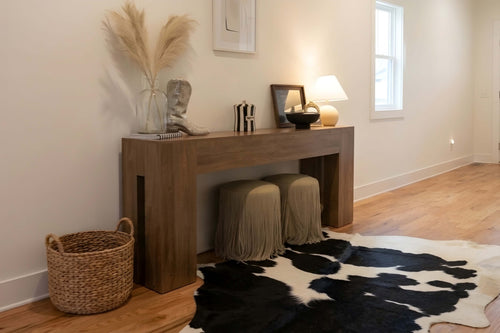
The before is useful context. Victoria's entryway was a clean, well-proportioned white hallway — warm oak hardwood floors, white walls, good natural light from the windows at the end of the corridor. A small folding stool with a cowhide seat sat in the corner beside the entry nook. It was a perfectly nice space that had absolutely nothing to say.
That's the most common version of a failed entryway — not ugly, not broken, just absent. A transitional zone that people move through without registering. The floors were good. The proportions were good. The bones were right. But there was nothing on the floor that gave the eye a reason to pause, and nothing in the space that communicated anything about the rooms beyond it.
Victoria knew the floor was the problem. She'd been thinking about a cowhide for the space — she liked the combination of natural material and graphic impact, she wanted something that would work with the warm oak floors rather than covering them up, and she needed a piece that could hold up to entryway use without requiring constant maintenance. The question was which pattern.
Why She Chose Black and White — and What the Hide Does in a Neutral Room

Victoria's entryway was running cool and neutral — white walls, warm oak floors, clean lines. Most design advice would steer her toward a warm-toned hide: tricolor, brindle, something that would add warmth to a cool-white space. She went the opposite direction.
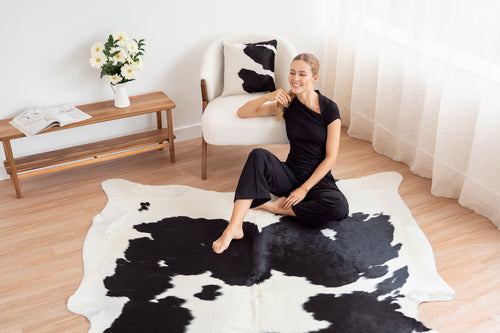
A Black and White Cowhide Rug in a white entryway is a counterintuitive move that works for a specific reason: in a room that's already doing nothing, maximum contrast is the fastest way to create presence. The black and white spotted pattern reads from the moment you walk in — the high contrast pattern pulls the eye downward before you've processed any other element of the space. The hallway that previously said nothing now says something the instant you enter.
The oak floors are the key factor that makes it work. Against warm honey-toned hardwood, the white ground of the hide picks up warmth from the floor beneath it — it reads as slightly warmer than it would against a cool grey or concrete floor. The black patches anchor the piece firmly to the floor rather than letting it float. The organic irregular shape of the hide — those ragged natural edges — softens what could otherwise read as too graphic in a narrow hallway. The shape provides the organic quality; the pattern provides the presence.
The practical argument was equally important. Victoria's entryway handles real daily traffic — boots, bags, the general coming and going of a busy household. The non-porous hair-on-hide surface of genuine cowhide handles tracked-in debris and moisture the way fiber rugs can't. Weekly shake-out, the occasional damp cloth if needed — that's the full maintenance ask. The eCowhides Cleaning and Care Guide covers the full protocol. For a space that gets as much use as an entryway, genuine cowhide is the most sensible floor material available.
"I went back and forth between tricolor and black and white for weeks. What finally decided it was realizing that the room was already warm — the oak floors were doing that work. I didn't need the rug to add warmth. I needed it to add presence. And black and white is the most present pattern in the collection." — Victoria Wilcox, @victoriaswilcox
The Console, the Fringe Stools, and the Chrome Boot: How the Full Entry Came Together

Once the hide went down, the entryway had a floor — but it needed a room built around it. Victoria's approach to styling the space above the hide is a case study in how to layer a transitional zone without overloading it.
The walnut console table came first. A substantial walnut-tone console — warm, low-profile, clean-lined — along the wall opposite the entryway nook. The warm wood against the white walls and the black and white hide creates the same bridge tone that makes the space cohere: the walnut sits between the warmth of the oak floors and the neutrality of the white walls, and it connects visually to the warm undertones in the hide's white ground.
The two khaki fringe stools tucked beneath the console are the detail that makes the space feel styled rather than furnished. The fringe texture — that vertical movement — adds dimension to the console's clean horizontal line. The khaki/olive tone sits in the earthy register that the black and white hide can accommodate without competing. They're also functional: seating at the entry for pulling on boots, a surface for bags. Design and function are the same decision.
The chrome cowboy boot on the console is the piece that makes the room personal. Against the warm wood, the striped ceramic canister, the framed mirror, and the gold lamp, the chrome boot sits as the unexpected object that tells you someone with a specific point of view lives here. It connects to the hide's Western-contemporary register without being literal about it — you don't need to know it's a cowboy boot reference for the room to feel right. But if you do know, it reads as knowing and deliberate. The Western Chic aesthetic Victoria is working within is one of 2026's strongest residential design trends.
The pampas grass in a glass vase is the height element — it extends the composition vertically and adds organic movement to a styling arrangement that's otherwise fairly horizontal and structured. The warm dried tone of the pampas connects to the oak floors and the walnut console, completing the warm-neutral material family. The gold lamp at the other end of the console provides the warm point light source that makes the whole arrangement look intentional at night.
Taking It Further: The Styled Living Area That Grew From the Same Hide

The entryway wasn't the end of the story. The same black and white hide that anchored the hallway entry informed how Victoria thought about the wider living space that opens from it.
The hide's graphic quality — that immediate high-contrast visual impact — established a design language for the home's entry zone: natural material, bold pattern, warm wood accents, objects with personality. That language is consistent enough that the console styling and the hide itself read as a single coherent design decision from the moment you walk in.
Victoria also wears the space — a detail worth noting because it tells you something about how a room works in real life. In the photos, she's standing on the hide in cognac cowboy boots, denim, a white top. The combination of her warm leather boots and the black and white hide beneath her is the Western-contemporary combination in its most natural form: not a styled shoot, just someone living in their home in the way it was designed to be lived in. The mirror selfie shot with the white eyelet top and tan boots captures the same quality — the room works as a backdrop because it has enough presence to be interesting without demanding to be the subject itself.
For anyone working with a similar transitional zone — white walls, warm wood floors, needing a floor piece that creates presence without overloading a narrow space — the Cowhide Placement 101 Guide covers the sizing and positioning logic for entryways and hallways specifically. The Decorate a Room Guide covers how to build the styling story above the hide from the floor outward.
"Once the hide was down, the rest of the entry came together faster than any room I've styled. It was like the floor gave everything else a direction. The console, the stools, the objects — they all made more sense once they had that black and white hide underneath them to organize around." — Victoria Wilcox, @victoriaswilcox
Victoria's Tips: What She'd Tell Anyone Styling a Transitional Space With Cowhide

Victoria has lived with the hide long enough to have a clear point of view on what works and what she'd do differently. Here's what she'd tell anyone attempting a similar entryway or hallway styling project.
Don't default to warm when neutral works better. The instinct in a cool or neutral room is to add warmth through the rug. Sometimes that's right — but sometimes the room is already warm enough through its floor material, and what it actually needs is presence rather than temperature. Ask yourself whether you need the room to be warmer, or whether you need it to have more to say. Those are different answers that lead to different patterns.
Let the hide's natural shape do work. The irregular organic edges of a natural cowhide are a design tool in a space with straight lines and clean walls. Victoria positioned the hide slightly off-center from the console rather than aligning it precisely — the organic shape reads as deliberate rather than accidental when it's slightly free from the architecture around it. Don't fight the hide's shape. Let it be natural.
Add one thing that's specifically yours. The chrome cowboy boot is the piece that makes Victoria's entryway hers rather than a designed entryway that could belong to anyone. Whatever your version of that object is — a specific ceramic, an inherited piece, an object with a story — the entryway is where it belongs. The hide provides the design foundation; the personal object provides the soul.
Think about height. Entryways tend to be horizontal compositions — console, hide, floor. Without something vertical, the space reads as flat. Pampas grass, a tall vase, framed art at the right height, a mirror — the vertical element is what makes a styled entry feel complete rather than just furnished.
Buy the hide that's meant for a high-traffic zone. Victoria specifically looked for a pattern that could handle daily entryway use without showing it visually between cleanings. Black and white is stronger for this than lighter patterns — the dark patches absorb visual noise, and the non-porous surface means spills and tracked-in debris stay on the surface rather than embedding. For the highest-traffic entryways in homes with children or pets, Brindle Cowhide Rugs are the most forgiving alternative — the tonal complexity hides everything.
FAQ: Entryway Cowhide Edition

What Size Cowhide Rug Works Best In An Entryway?
Depends on the entry format. For a narrow hallway, a full natural hide sized to leave 6–12 inches of floor visible on either side creates the framed look without the hide fighting the architecture. For a wider foyer, a larger hide can anchor the full entry zone. Cowhide Runners (6x2 and 8x2 ft) are the right format for long, narrow hallways where a full hide's irregular shape doesn't fit as naturally.
Is Black and White Cowhide Good For an Entryway?
Yes — particularly in neutral rooms where the high-contrast pattern creates the presence the space needs. The non-porous surface handles entryway traffic, tracked-in debris, and moisture without absorbing or degrading. For rooms with very dark floors, a Tricolor Cowhide Rug or Brindle Cowhide Rug creates a warmer, softer transition.
How Do I Style an Entryway Console With a Cowhide Rug?
Three rules: anchor with a height element (pampas grass, tall vase, mirror), balance with a horizontal layer (books, tray, low ceramic), and add one personal object that's specifically yours. The console styling above a cowhide works best when it picks up a tone from the hide — warm wood connects to the hide's warm undertones, black accessories connect to black patterns, warm metal to the hide's lighter tones.
What Is the Best Cowhide Pattern For a White-Walled Entry?
Black and White Cowhide Rugs for maximum graphic presence — the high contrast reads powerfully against white walls. Tricolor Cowhide Rugs for a warmer, more inviting entry that adds color temperature to a cool-white space. The choice between the two comes down to whether you want presence (black and white) or warmth (tricolor) as the entry's primary statement.
Does A Cowhide Rug Work In A Narrow Hallway?
Yes — the organic natural shape of a cowhide is actually more flattering in a narrow hallway than a rectangular rug, because the irregular edges don't emphasize the hallway's narrow proportions the way a rectangular rug does. The hide sits naturally in the space rather than drawing attention to the corridor's dimensions. Position it with the widest part of the hide in the widest part of the hallway.
How Do I Maintain a Cowhide Rug In a High-Traffic Entryway?
Weekly shake-out — loose debris doesn't embed in the non-porous surface. Blot moisture immediately with a dry cloth. Spot clean with mild soap and a barely damp cloth for anything that needs more than a shake-out. No soaking, no steam cleaning. In a busy entryway, the non-porous surface means maintenance is genuinely minimal — the hide handles what would destroy a fiber rug without requiring any special treatment. Full care instructions at the eCowhides Cleaning and Care Guide.
What Goes With a Black and White Cowhide Rug In an Entry?
Warm wood furniture (walnut, oak, ash) bridges the black and white pattern to the room's floor and walls. Black accessories connect to the hide's dark patches. Organic textures — pampas grass, rattan, fringe — soften what could otherwise read as too graphic. Warm point lighting (a lamp, sconce) makes the white ground of the hide glow at night. One personal object with a specific story makes the room yours rather than designed.
Can I Use a Cowhide Runner In a Hallway Instead of a Full Hide?
Yes — Cowhide Runners in 6x2 and 8x2 ft are specifically designed for hallway and entryway use. They work particularly well in hallways that are too narrow for a full natural hide's organic shape to sit comfortably. Colombian Tricolor Runners are handmade and the warmest choice for a welcoming entry feel; Brazilian Patchwork Runners add the geometric grid structure that reads well in transitional zones.
How Do I Choose Between a Cowhide and a Runner For My Entryway?
Narrow hallways where floor visibility on either side would be limited: runner. Wider entry zones where a full organic hide shape has room to breathe: full hide. Foyers with a clear center floor area and surrounding furniture: full hide. Long corridors connecting multiple rooms: runner. Budget-conscious buyers who want genuine cowhide in the entry at the most accessible price point: Cowhide Runner from $99.99.
Where Can I Find the Same Black and White Cowhide Rug Victoria Used?
Browse the full Black and White Cowhide Rug Collection at eCowhides — every piece is individually photographed so you see the exact hide available before you buy. The specific distribution of black and white varies piece to piece; browse until you find the balance that works for your specific entry. Follow Victoria's full home styling journey at @victoriaswilcox.
One Hide. The Whole Entry Changes.

Victoria's entryway is proof of what a single floor decision can do to a transitional space. The white hallway that had nothing to say now says something the moment you walk through the door — and everything that was already there (the oak floors, the proportions, the light) looks better for having the hide beneath it.
Browse the full Black and White Cowhide Rug Collection and the complete Cowhide Rug Collection at eCowhides.com. Every piece one of a kind. Every piece the real thing. Follow Victoria's home at @victoriaswilcox.