Some rooms take a long time to figure out. You have the furniture, you have the bones — and the walls and floor stay unresolved for months because nothing you try feels like it belongs. That was Hailey Ward's living room. She already had the terracotta channel-tufted sofa, the matte black organic coffee table, the sage green puff. The pieces were good. The room around them wasn't doing them justice.
Two decisions changed everything: painting the walls forest green, and laying a Dark Tricolor Cowhide Rug from eCowhides over a rust area rug. Here's the full story — and what Hailey would tell anyone trying to do something similar.
How the Full Room Came Together: Green, Terracotta, Black & Natural Hide

The completed room is a case study in how to use bold color with natural materials without either overwhelming the other — and in how the right walls can unlock furniture you already own.
Hailey had the terracotta sofa, the black organic coffee table, and the sage green puff before the renovation started. Against white walls, they were good pieces in a room that wasn't doing them justice. Against forest green, they became exactly what they were supposed to be. The wainscoting panels give the green a structured, tailored quality — the color reads bold but not aggressive, contained within those framed sections. The terracotta sofa against it creates the high-contrast warmth that makes you stop in the doorway.
The floor ties it together. The rust area rug warms the hardwood and extends the room's earth-tone story all the way down. The dark tricolor cowhide on top brings natural material into a room that's otherwise all upholstery, paint, and crafted furniture. That natural quality — the organic silhouette, the hair-on-hide texture, the one-of-a-kind markings — is what gives the room its character. It's also what makes it the right room for a baby. Non-porous, allergen-resistant, easy to clean when life happens on the floor. Beautiful and practical are the same choice here.
For anyone thinking about a similar color combination, the Decorate a Room Guide covers building a complete room palette from a cowhide anchor outward. The Rug Color Guide at Chris Loves Julia is also worth reading for the green-and-warm-tone palette specifically.
"The hide is the thing in the room that isn't trying. Everything else — the sofa, the walls, the lighting — those were all decisions. The dark tricolor just exists, naturally, and it makes everything around it feel more real. And knowing my baby is crawling on something that's actually clean — not just vacuumed but genuinely non-porous — that matters more than any of the design stuff." — Hailey Ward
The Room Before: White Walls, Great Furniture, Missing Something

Before the green, the room was white. Bright, clean, builder-white walls with wainscoting panels Hailey had installed herself — you can see her leveling them in the renovation photos, nail gun nearby, baby crawling on the floor beside her. The furniture she already owned was warm and rich: the terracotta sofa, the black coffee table with its organic silhouette, the sage green round puff. All of it sitting against white walls that gave nothing back.
She'd been living with a neutral area rug — fine, functional, nothing that added to the room's character. It did its job and disappeared. With a new baby in the house, the floor question also became a practical one: whatever went down had to be safe, easy to clean, and forgiving of the kind of daily life a crawling baby contributes to a living room.
The renovation came in two moves. First, she painted the walls forest green — a deep, saturated color that immediately transformed how the furniture read. The terracotta sofa against forest green created the high-contrast warmth she was after. Then she started looking at what to put on the floor that could hold its own in a room that was suddenly very alive.
She started looking at natural hides.
Why She Chose Dark Tricolor — and How She Found the Right Hide

Hailey's research led her through most of the natural cowhide pattern options before she landed on dark tricolor. She looked at brindle — rich but warmer than what she was aiming for. Black and white was too graphic for a room that already had a lot going on. Chocolate and white had the right temperature but she wanted more depth and movement in the pattern.
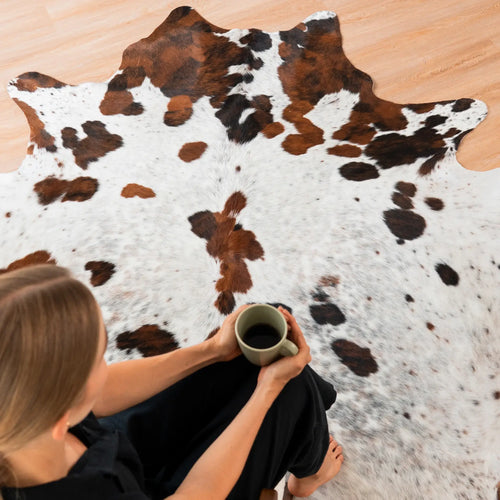
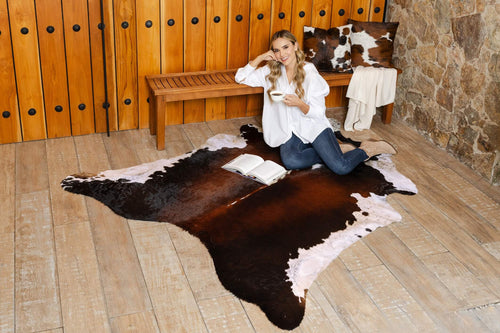
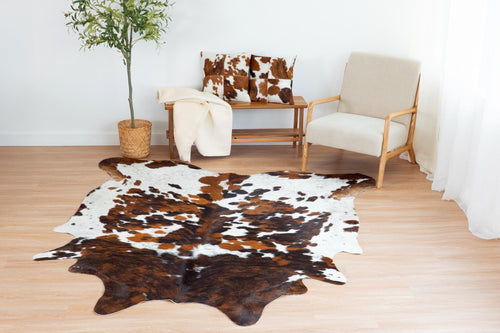
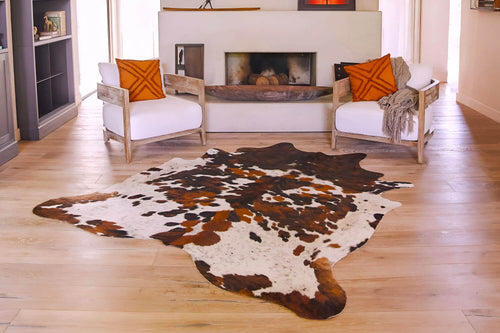
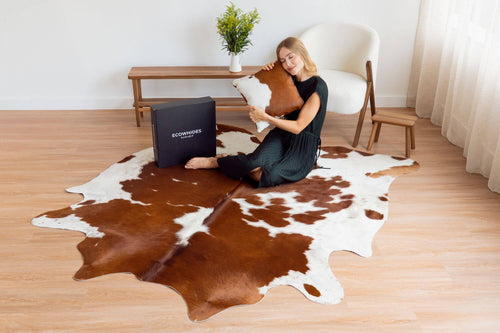
Dark Tricolor Cowhide was the answer. The three-tone spotted pattern — deep dark brown, warm caramel, and ivory — gave the floor the organic complexity the room needed. The dark tones anchor the hide against the forest green walls. The caramel sits in the same warm family as the terracotta sofa without directly echoing it. The ivory patches catch the light and stop it from reading too heavy. Against bold walls and bold upholstery, dark tricolor holds its own through visual complexity rather than contrast alone.
With a baby in the house, there was a practical layer to the decision too. Hailey needed something that wouldn't trap dust mites, dander, or allergens at depth the way fiber rugs do — the kind of material that stays genuinely clean rather than just looking clean on the surface. Genuine cowhide is naturally hypoallergenic: the non-porous hair-on-hide surface doesn't provide the embedded environment allergens need to accumulate, which matters enormously in a room where a baby is crawling on the floor daily. The Allergy-Free Cowhide properties that made it the right choice for a family room weren't an afterthought — they were part of why natural hide made sense here in the first place.
Finding the right individual piece still mattered. Hailey spent time browsing the Dark Tricolor Cowhide Rug Collection until she found a hide with the right tonal distribution — enough ivory to catch light on the floor, dark brown tones that grounded the room, and warm caramel in between. The fact that eCowhides photographs each one-of-a-kind piece individually meant she knew exactly what she was getting before it arrived.
The organic irregular shape of the natural hide was also part of the appeal. In a room with so many structured, geometric elements — wainscoting panels, channel-tufted sofa, square coffee table — the natural silhouette of the hide added an element of organic movement that the room needed.
"I looked at probably thirty different hides before I found mine. The dark tricolor I went with has this incredible depth — the three tones move across the surface and catch the light differently depending on where you're standing. When the morning light hits it, the whole room shifts. That's not something you get from a manufactured rug." — Hailey Ward
The Layering Move: Cowhide Over a Rust Area Rug

Here's the decision that changed everything — and the one Hailey gets asked about most.
Hailey sourced a rust-toned area rug specifically to use as a base layer — different from the neutral rug she'd been living with before. The rust was chosen intentionally: she wanted a warm border that would frame the cowhide and extend the room's terracotta and earth tone story all the way to the floor. The cowhide went on top. The layering created something neither piece achieves alone. The rust rug provides a warm, substantial border. The cowhide sits on top as the visual anchor — the piece the eye goes to first, the one that connects the floor to the room's color story.
The tonal relationship between the rust base and the dark tricolor cowhide is part of why it works. Both are in the warm, earthy register — the rust rug and the dark tricolor hide share enough temperature to read as intentionally layered rather than accidentally stacked. The white patches in the cowhide create the contrast that keeps it from blending in. The result is a floor that has depth — layers you can see — in a way that a single rug simply doesn't.
The practical mechanics of rug layering are simple. The cowhide sits slightly off-center on top of the area rug — positioned so the front legs of the sofa and chair land on the hide, with the rust rug visible as a frame around the edges. A non-slip pad underneath the cowhide keeps it in place. For the full technique, BHG's How to Layer Rugs and 5 Tips for Layering Rugs cover the proportions and positioning well.
The Cowhide Placement 101 Guide covers sizing logic for layering specifically — how big the cowhide should be relative to the base rug, and how much of the base rug to leave visible on each side.
Hailey's Tips: What She'd Tell Anyone Styling a Bold Room With Cowhide

After living with the room for several months, Hailey has a clear point of view on what worked and what she'd do differently. Here's what she'd tell anyone attempting something similar.
Don't be afraid of warm-on-warm. The instinct is to balance warm walls and warm upholstery with something cool or neutral on the floor. Hailey went the other direction — rust, terracotta, and dark tricolor all in the same warm family — and the room reads as richer for it rather than overwhelming. Warmth compounds in a good way when the tones are varied enough in depth and saturation.
Let the organic shape do work. In a room with structured, geometric elements — wainscoting, channel-tufted sofa, square coffee table — the irregular natural silhouette of a cowhide creates a visual counterpoint that the room needs. Don't center it perfectly or fight its shape. Let it sit naturally and it brings an ease the room wouldn't have with a rectangular rug.
Size up. Hailey's one regret is not going slightly larger with the hide. In a room with a substantial sofa and a layered rug situation, the cowhide wants to be generous. The rule she'd apply now: front legs of all seating pieces on the hide, with the base rug visible as a frame. Emily Henderson's Rug Size Guide is the reference she wishes she'd consulted before ordering.
Choose your base layer with intention. Hailey didn't use the rug she already had — she sourced a rust area rug specifically to layer under the cowhide. The base layer is part of the design decision, not just a functional underlay. Think about what color and tone you want framing the hide, and choose accordingly. The base rug and the cowhide should share a color temperature so the layering reads as designed rather than accidental.
Choose the individual piece carefully. Because every cowhide is genuinely different, the specific distribution of tones on your hide matters. Hailey spent time browsing until she found the right balance. The Dark Tricolor Cowhide Rug Collection shows each piece individually — use that. Don't settle for a hide that's almost right when the right one is there if you look.
FAQ: Dark Tricolor Cowhide Edition

What Is A Dark Tricolor Cowhide Rug?
A Dark Tricolor Cowhide Rug is a genuine hair-on-hide natural rug featuring the three-tone natural spotted pattern — deep dark brown, warm caramel, and ivory — in a rich, dark variation where the brown tones dominate. The coloring is natural to the animal, not dyed. Every piece is one of a kind.
Does Cowhide Work With Dark Green Walls?
Yes — and particularly well. Dark green walls create a rich, saturated backdrop that warm natural cowhide tones sit beautifully against. Dark tricolor, brindle, and warm natural patterns all work beautifully in this context. The warm brown tones in the hide connect to the warmth embedded in most deep greens, while the natural organic shape of the hide softens the structured quality that dark-walled rooms can carry.
How Do You Layer A Cowhide Rug Over Another Rug?
Place the cowhide on top of a larger base rug — the base rug should extend beyond the cowhide on all sides, creating a visible frame. Position the cowhide so the front legs of your main seating pieces sit on the hide. Use a non-slip pad underneath to prevent movement. The base rug and the cowhide should share a color temperature — warm under warm, cool under cool — so the layering reads as intentional. BHG's How to Layer Rugs covers proportions and placement in detail.
What Colors Work With A Dark Tricolor Cowhide Rug?
The three-tone pattern — dark brown, caramel, ivory — works in warm and rich room environments: terracotta, forest green, navy, warm whites, and cognac leather all pair well. The multi-tonal structure means it adapts across warm palettes naturally, sitting equally well against bold walls and neutral surroundings. Warm wood furniture, dark bronze or brass hardware, and linen or cotton textiles in warm neutrals all complement a dark tricolor cowhide naturally.
Can A Cowhide Rug Be Layered Over A Flat Woven Rug?
Yes — flat woven rugs (cotton, jute, sisal, low-pile synthetic) are the best base layers for cowhide. The flat surface prevents the cowhide from shifting and allows the hide to lay completely flat. Deep pile or shag rugs don't work as base layers — the cowhide won't lay flat and the combination looks unstable. A non-slip pad between the two keeps everything in place.
Is Dark Tricolor Cowhide Good for High-Traffic Living Rooms?
Yes — the deeper tones of dark tricolor handle everyday wear and light debris visually better than lighter patterns, and the non-porous hair-on-hide surface resists spills and doesn't trap allergens or pet hair. The Cowhide Durability Guide covers long-term performance in detail.
How Do I Style A Cowhide Rug With A Terracotta Sofa?
Stay in the warm family — dark tricolor, brindle, or chocolate and white all complement terracotta without competing with it. Avoid cooler patterns like grey or black and white, which can fight the warmth of the upholstery. The key is tone temperature: warm sofa, warm hide, warm wall (if bold) creates a room that feels cohesive and intentional. Let one element be the visual lead — typically the sofa or the walls — and let the hide be the grounding force beneath it.
What Size Cowhide Rug Should I Use In A Living Room?
Large enough that the front legs of all major seating pieces sit on the hide — this creates a unified seating zone rather than a rug floating in the middle of the room. In a living room with a full sofa and chairs, that typically means a substantial hide in the larger size range. When in doubt, size up — slightly larger is almost always better than slightly smaller. Emily Henderson's Rug Size Guide covers every room format precisely.
How Do I Clean A Dark Tricolor Cowhide Rug?
Shake it out weekly. Blot spills immediately with a dry cloth — never rub. Spot clean with mild soap and a barely damp cloth, working in the direction the hair lays. Air dry at room temperature. The full care protocol is in the eCowhides Cleaning and Care Guide.
Where Can I Find The Same Dark Tricolor Cowhide Rug Hailey Used?
The Dark Tricolor Cowhide Rug Collection at eCowhides shows every currently available piece individually photographed — what you see is what ships. Browse the full collection to find the hide with the right tonal distribution for your specific room. No two are alike.
The Piece That Made the Room Make Sense

Hailey's living room is the kind of space that takes time to figure out — and then, suddenly, clicks. The forest green walls. The terracotta sofa. The black coffee table. The rust base rug with a dark tricolor cowhide laid over it, its organic silhouette sitting naturally on the floor like it grew there.
That's what a genuine natural hide does in the right room. It doesn't try to hold its own against the bold decisions around it — it grounds them. Makes them feel more considered. Turns a carefully assembled room into a room that actually feels lived in.
Want to follow Hailey's home journey? She shares the full renovation process, styling decisions, and everyday life in this room on Instagram at @hayley_golucky.
Browse the full Dark Tricolor Cowhide Rug Collection at eCowhides.com. Every piece photographed individually. Every piece one of a kind. Find the one your room has been waiting for.