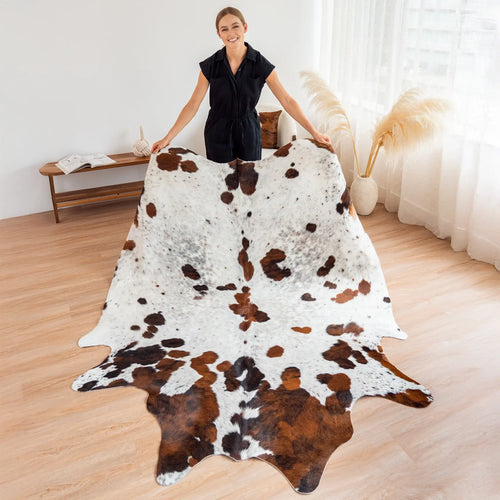
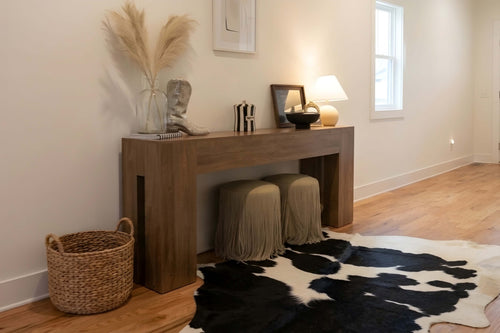
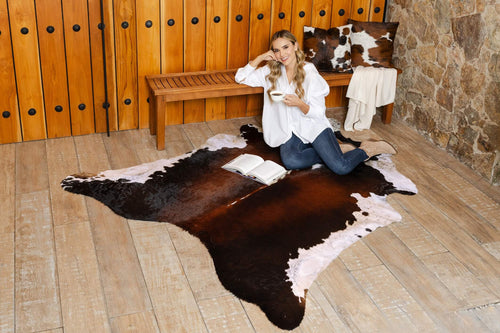
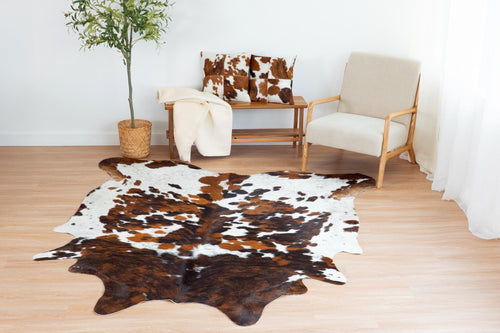
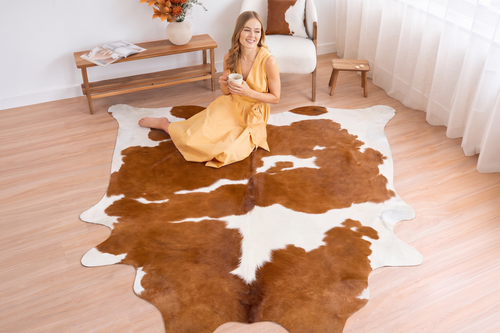
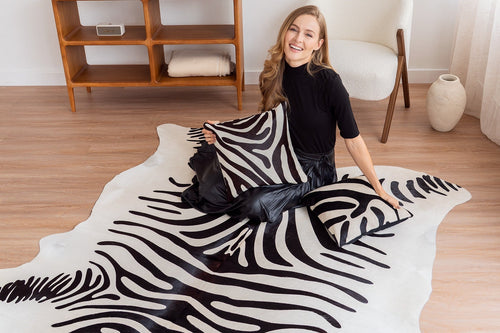
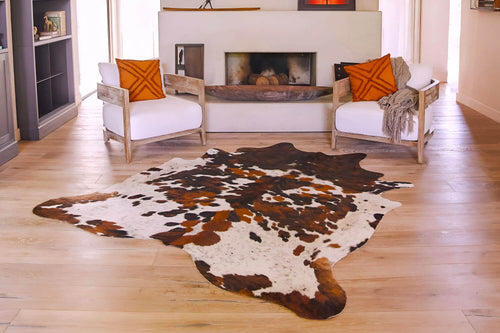
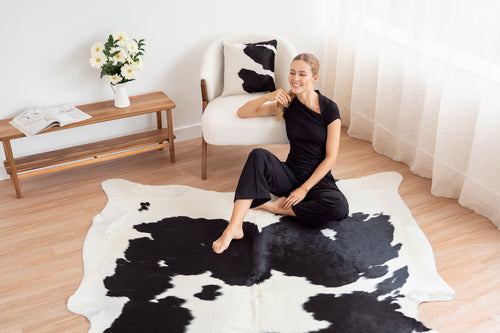
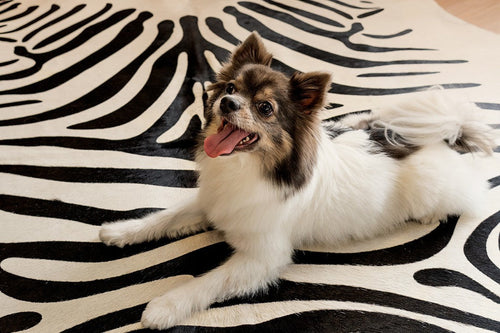
Some rugs sit quietly in a room and do their job. A Black and White Cowhide Rug doesn't do that. It arrives with a point of view. The high-contrast spotted pattern — natural, organic, completely unrepeatable — reads from across the room before you've registered anything else about the space. If the room isn't ready for that, it's too much. If the room is ready, it's exactly right.
The most graphic pattern in the eCowhides collection is also the most misunderstood. People are drawn to it immediately and then unsure how to use it. This guide closes that gap.
What Makes Black and White Cowhide the Most Graphic Pattern in the Collection

Every natural cowhide pattern has its own visual character. Tricolor Cowhide Rugs are warm and organically rich. Brindle Cowhide Rugs are textured and directional. Brown and White Cowhide Rugs are classic and grounded. But black and white operates at a different register — and the reason is contrast.
High contrast is the most powerful design tool available. The human eye reads contrast before anything else — which is why a black and white hide on a room's floor pulls attention before the furniture, before the art, before the wall color. The spotted pattern of natural black and white cowhide is not a printed design. It's the actual marking of the animal — each patch of black against the white ground occurring in a distribution that no two hides replicate. That natural origin gives the pattern something printed alternatives can't achieve: organic variation within a graphic framework.
|
Pattern |
Contrast Level |
Visual Weight |
Room Role |
|
Maximum |
High — reads from across the room |
Anchor piece — defines the room |
|
|
Medium-high |
Medium-high — warm and complex |
Anchor piece — sets the tone |
|
|
Low-medium |
Medium — textured, directional |
Foundation piece — supports everything else |
|
|
Medium |
Medium — classic, timeless |
Versatile — works across most room contexts |
|
|
Minimal |
Low — light, airy, recessive |
Supporting piece — lets everything else lead |
The graphic quality of black and white cowhide also makes it one of the strongest natural hide patterns for wall art — hung on a white or concrete wall, a large black and white hide reads as a piece of art at a scale and organic complexity no framed print can replicate. The 2026 Interior Design Trends post covers the wall art application in detail.
"Black and white cowhide is one of those patterns that knows exactly what it is. It's not trying to be subtle. And in a room that's ready for that — minimal furniture, clean lines, nothing competing at the same visual register — it's one of the most satisfying floor pieces I know how to specify." — Laurent Dubois, Principal Designer, Dubois Studio, New York NY
The Rooms Where Black and White Cowhide Is Absolutely at Its Best

Black and white cowhide is not a neutral. It's a statement. Which means it performs best in rooms ready to receive a statement — and requires more care in rooms that already have too many statements competing for attention.
Minimalist Living Rooms: The ideal context. A black and white hide anchoring a clean-lined seating area — white walls, light furniture, nothing unnecessary — is one of the most powerful design combinations in residential interiors. The hide provides all the visual interest the room needs. Nothing else has to work hard. Front legs of all major seating pieces on the hide, pattern visible from the entry. Emily Henderson's Rug Size Guide for proportions, the Cowhide Placement 101 Guide for positioning.
Scandinavian and Nordic-Style Rooms: The black and white spotted pattern is essentially native to this aesthetic — organic, natural, graphic, no synthetic color. Against white walls, light wood furniture, and minimal accessories, a black and white hide is the natural material anchor that brings warmth and life to a palette that can otherwise read as cold.
Contemporary Home Offices: A black and white cowhide under a desk or anchoring a sitting area adds the design detail that separates a workspace that looks considered from one that just has furniture in it. The pattern also reads well on video calls — visual interest without distraction.
Modern Dining Rooms: Under a dark dining table with black metal chairs, a black and white hide creates a high-contrast graphic composition at floor level that makes the whole room feel designed. Keep surrounding walls light and the table setting simple — the hide carries the visual load.
Where it requires more care: Busy rooms with bold wallpaper, colorful art, or patterned upholstery — the black and white can add chaos rather than drama. And very dark floors — the contrast between the hide's white ground and a very dark floor can read too sharp. On dark floors, a Brindle Cowhide Rug or Brown and White Cowhide Rug creates a warmer, softer transition.
Color Pairing 101: The Palettes That Make Black and White Cowhide Pop

Black and white is the most chromatic base palette in interior design — it pairs with virtually every color, but pairs with some colors far better than others.
All-white and off-white: The cleanest context. White walls, white or cream furniture, minimal color — and the black and white pattern does all the work. The natural variation in the white ground of a genuine hide (slight warm undertones, organic tonal shifts) prevents the combination from reading as clinical. The Scandinavian interior at its best.
Warm grey and charcoal: Deep grey or charcoal walls with a black and white hide create a sophisticated, moody contemporary combination. The black in the hide connects to the wall color; the white ground creates the contrast that keeps the room from going dark. Best with warm artificial lighting to prevent a cold reading.
Deep navy: Navy walls with a black and white cowhide is one of the stronger contemporary residential pairings. The navy reads as the room's color anchor; the black and white provides the floor's graphic energy. Works best with brass or gold hardware and warm wood accents that bridge the two.
Warm camel and cognac: Camel or cognac leather furniture against a black and white hide creates the classic Western-contemporary combination — graphic on the floor, warm in the upholstery, nothing fighting for attention between them. Difficult to get wrong. Consistently among the most requested combinations in interior design in 2026. The Western Chic trend driving this pairing is well-documented.
What to avoid: Visually busy rooms where black and white adds noise rather than organization. Red walls — this combination requires extreme precision to avoid looking like a graphic design project rather than a room. For palette-matching guidance, the Rug Color Guide at Chris Loves Julia covers every scenario.
"Black and white cowhide with camel leather furniture is a combination I return to consistently — graphic floor, warm upholstery, each making the other look better. It's the kind of pairing where neither element achieves the same result alone. Together they feel like the room was always supposed to look exactly like this." — Ana Hartmann, Senior Interior Stylist, Hartmann Design, Chicago IL
Black and White Cowhide Pillows & Layering: Building a Complete Room Look

A black and white cowhide rug on the floor is a strong design statement. The complete room look comes from connecting it to other elements — at different heights and in different formats — in a way that feels intentional rather than matched.
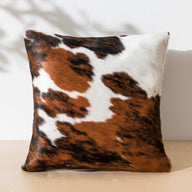
Pillow pairing on the sofa: Pair a black and white Cowhide Pillow with a natural brindle or tricolor pillow rather than matching the rug exactly. The variation within the same material family is more interesting than a matched set — because no two genuine pieces are identical, a black and white pillow alongside a black and white rug creates variation rather than repetition. For a more geometric accent, a Patchwork Cowhide Pillow introduces structured geometric contrast that plays off the organic spotted pattern of the hide. Available in 15x15, 20x20, and 12x20 lumbar. Backing: Fabric Backing for softer sofa placement, Leather Backing for a tailored finish, Cowhide Backing for maximum texture.
Rug layering: A black and white cowhide as a top layer over a larger natural fiber base — jute or sisal in a natural undyed tone — creates a striking combination. The graphic pattern reads clearly against the rough organic texture of the base; the natural fiber provides warmth and a visual border that frames the hide without competing. Avoid patterned base rugs — competing patterns fight rather than complement. BHG's How to Layer Rugs and 5 Tips for Layering Rugs cover mechanics and proportions.
Runner in adjacent zones: A natural-pattern Cowhide Runner — brindle or tricolor — in an adjacent hallway extends the natural material story from the main room without doubling down on the black and white. The organic natural pattern in the hallway and the graphic black and white in the main room create variety within the same material family.
For the full room-building approach from the rug outward, the Decorate a Room Guide walks through the process step by step. The Cowhide Decor Ideas at Untamed Creatures is worth bookmarking for styled room inspiration.
Natural vs. Printed Black and White: Why Authentic Pattern Always Wins

The faux cowhide market has gotten technically sophisticated — printed black and white patterns on synthetic backing that, from a catalog photo, can be genuinely difficult to distinguish from the real thing. In person, the difference is immediate and definitive.
What faux black and white is: A printed pattern on a synthetic or fabric base, designed to resemble natural cowhide spotting. The distribution is manufactured — regular enough to look natural but produced rather than grown. The backing is fabric or synthetic, not natural suede. Any hair is synthetic fiber — uniform in length, texture, and direction.
What authentic black and white cowhide is: The actual marking distribution of a specific animal, preserved in hair-on-hide form. The black patches are where the animal was black. The white ground is where it was white. Completely natural distribution — which means organic variation that printed patterns can approximate but never achieve. No two authentic black and white hides are identical. Every printed faux of the same SKU is identical to every other unit.
In person, the difference shows immediately across four dimensions:
- Surface feel. Natural hide has weight, dimensional depth, and a surface quality — the slight sheen of the hair, the way it shifts with light — that synthetic materials don't replicate.
- The backing. Flip it over. Genuine cowhide has a soft, suede-like natural leather backing with visible fiber structure. Synthetic alternatives have fabric, felt, or coated backing.
- Pattern edges. On genuine hide, the transition from black to white is soft and organic — the way real hair coloring transitions. On printed faux, the color boundaries are slightly sharp, like a printed edge.
- Performance. Non-porous genuine hide repels spills. Faux fabric-backed alternatives absorb immediately. Genuine cowhide lasts 20+ years. Faux cowhide lasts as long as any synthetic rug — 1–3 years before visible degradation. And genuine cowhide is a Byproduct of the Meat Industry; faux is a petrochemical synthetic.
The Real or Faux Guide covers every distinguishing test in detail. The Why Real Beats Faux post makes the full performance and longevity comparison. The Faux vs Real Comparison answers the direct question head-on.
FAQ: Black and White Cowhide Edition

What Makes Black and White Cowhide the Most Graphic Natural Hide Pattern?
Maximum contrast — black against white is the highest-contrast combination available in natural hide coloring. The human eye reads contrast before anything else, which means a Black and White Cowhide Rug pulls attention from across a room before any other element registers. Combined with the organic variation of natural spotted markings, it creates a graphic quality no manufactured pattern can fully replicate.
What Rooms Work Best With A Black and White Cowhide Rug?
Minimalist living rooms, Scandinavian and Nordic-style spaces, contemporary home offices, and modern dining rooms. The pattern works best in rooms with clean lines, minimal additional pattern, and enough visual space for the hide to be the room's primary statement. It requires more care in busy, colorful, or visually complex rooms.
What Wall Colors Work Best With Black and White Cowhide?
White and off-white for the cleanest, most graphic result. Warm grey or charcoal for a sophisticated contemporary feel. Deep navy for a bold modern combination. Warm camel or cognac in the upholstery creates the classic Western-contemporary pairing. Avoid visually busy wall treatments and be cautious with red — it requires precise handling alongside black and white.
Can I Use A Black and White Cowhide Rug In A Minimalist Room?
Yes — and minimalist rooms are where it performs best. A Black and White Cowhide Rug in a minimal room provides all the visual interest the space needs. White walls, light furniture, the hide on the floor — that's a complete room.
How Do I Style Black and White Cowhide Pillows With the Rug?
Pair a black and white Cowhide Pillow with a natural Brindle Cowhide Pillow or Tricolor Cowhide Pillow rather than matching the rug exactly. The variation within the same material family is more interesting than a matched set. Available in 15x15, 20x20, and 12x20 lumbar.
What Is The Difference Between Natural and Printed Black and White Cowhide?
Natural black and white cowhide carries the actual marking distribution of a specific animal — organic, unrepeatable, hair-on-hide with a natural suede leather backing. Printed faux applies a manufactured pattern to synthetic or fabric backing — uniform, repeatable, indistinguishable unit-to-unit. In person the difference is immediate: natural hide has weight, surface depth, and a quality synthetic materials don't replicate. The Real or Faux Guide covers every distinguishing test.
Can I Layer A Black and White Cowhide Over Another Rug?
Yes — over a natural fiber base (jute, sisal, natural undyed seagrass) where the graphic pattern reads clearly against the rough organic texture. Avoid patterned base rugs — competing patterns fight. Use a non-slip pad underneath. The base rug should be larger than the cowhide, visible as a frame on all sides. BHG's How to Layer Rugs covers proportions.
Is A Black and White Cowhide Rug Good For Homes With Pets?
Yes — with a practical note on the white ground. The white sections will show dirt and debris more visibly than darker patterns between cleanings. In a home with heavy outdoor pet traffic, a Brindle Cowhide Rug is the lower-maintenance choice. In lower-traffic rooms, black and white is fine. The Pet-Friendly Homes Guide covers the full picture.
How Long Does A Black and White Cowhide Rug Last?
20+ years with basic care — the same as any natural hide. The Cowhide Durability Guide documents what long-term ownership looks like. Natural cowhide develops character over time — the tones deepen slightly, the surface settles — rather than degrading.
Can A Black and White Cowhide Rug Be Used As Wall Art?
Yes — it's one of the strongest patterns for wall application. The high-contrast spotted pattern reads as a graphic artwork from across the room, and the organic shape of a natural hide gives a wall dimensional, textured presence that no framed print achieves. Hang using a wooden dowel through a fabric sleeve along the top edge, lit from above for maximum impact.
The Most Graphic Floor in the Room — and the One That Never Needs Anything Else

A black and white cowhide rug makes a room complete without requiring additional effort. Put it in the right room — clean, minimal, with enough visual space for the pattern to breathe — and the design work is done. Everything else just has to stay out of its way.
Browse the full Black and White Cowhide Rug Collection at eCowhides.com. Add a natural Cowhide Pillow on the sofa and a Cowhide Runner in the hallway. One material family. One cohesive story. Each piece one of a kind — exactly like it should be.