Pet owners have a different relationship with their rugs than everyone else. They don't just think about how a rug looks — they think about what happens when the dog shakes mud on it at 7am, or the cat knocks over a full water glass, or pet hair accumulates faster than any vacuum can keep up with. The rug question for pet owners is fundamentally a performance question, not a style question.
Most rugs fail this test. They absorb accidents, trap hair at depth, hold onto odors, and degrade visibly under the kind of daily use that pets add to a household. And they get replaced. Again and again.
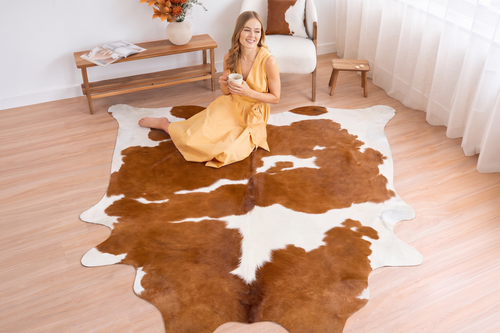
A Cowhide Rug handles pet households differently — structurally differently, not just marginally better. Here's the complete picture.
Why Most Rugs Fail in Homes With Pets — and What's Different About Cowhide

The failure modes of conventional rugs in pet households are predictable. Understanding them makes the cowhide advantage obvious rather than a matter of brand preference.
Fiber construction absorbs everything. Woven and tufted rugs — wool, polypropylene, cotton, jute — are made of fibers. Those fibers absorb liquid. A pet accident on a fiber rug doesn't sit on the surface — it moves immediately downward, through the pile, through the backing, and into whatever's underneath. The window for effective cleanup is measured in seconds, not minutes. Miss it and you're dealing with a stain and an odor that live in the fiber structure long after the surface looks clean.
Pet hair embeds rather than sitting on the surface. The pile structure of fiber rugs creates an ideal environment for pet hair to embed itself — the fibers grip individual hairs and hold them below the surface, where regular vacuuming can't reach them efficiently. Deshedding season in a household with a double-coated dog on a fiber rug is its own particular kind of problem.
Allergens accumulate at depth. Pet dander — the actual allergen trigger for most pet allergy sufferers — attaches to fiber at depth. The Carpet Allergy research is clear: soft floor coverings in active pet households accumulate biological material that affects indoor air quality in ways that vacuuming alone can't address. For households with allergy-sensitive members, this is a clinical issue, not just a comfort one. The Indoor Environmental Quality Research confirms the connection between fiber floor coverings and elevated allergen loads.
Odors persist in fiber. Organic material — pet accidents, mud, the general smell of a wet dog — bonds to fiber at the molecular level. You can clean the surface and neutralize the smell temporarily, but in a fiber rug with repeated exposure, odor becomes structural. The Dangers of Wet Carpets documentation covers the mold and bacterial risks that come with moisture-prone fiber rugs in active households.
Genuine cowhide has none of these failure modes — because they all originate in the same structural property that cowhide doesn't have: porous fiber construction. The hair-on-hide surface of a natural cowhide doesn't absorb, doesn't embed, doesn't trap. It's non-porous. And non-porous changes everything for pet households.
"I specify cowhide for every client who has pets and cares about their floor. Not as a compromise — as the best possible choice. The performance difference between a cowhide and a fiber rug in a pet household isn't marginal. It's structural." — Diana Webb, Interior Designer & Natural Materials Specialist, Austin TX
Pet Hair, Accidents & Muddy Paws: How Natural Hide Handles All of It
Theory is one thing. Here's what actually happens with the specific messes that pet owners deal with daily.
Pet hair: On a cowhide, pet hair sits on the surface. It doesn't embed. The smooth, dense hair-on-hide surface doesn't grip individual pet hairs the way looped or cut pile fiber does — dog or cat hair lands on the cowhide and stays accessible. Most of it brushes off easily with your hand or a light pass with a flat vacuum attachment. During heavy shedding seasons, a slightly damp rubber brush or a lint roller handles what remains. The whole process takes about two minutes and leaves the hide looking clean.
Pet accidents: This is where the non-porous surface earns its place most definitively. On a cowhide, urine doesn't immediately soak in — it sits on the surface, giving you a real window to act. Blot firmly with a dry cloth, pressing into the liquid and lifting without rubbing. Work from the outside edge of the spill inward. For residual odor, a solution of equal parts water and white vinegar applied on a barely damp cloth neutralizes it effectively. Let the hide air dry completely. If you catch it quickly, there's no staining and no lasting odor. On a fiber rug, the same accident handled with the same speed would still result in odor that outlasts the cleanup.
Muddy paws: The standard advice — let it dry first — applies here. Allow mud to dry completely on the surface of the hide, then brush off the dry debris before any damp cleaning. Trying to clean wet mud pushes it into the hair surface; dry mud brushes away cleanly. A barely damp cloth with mild soap handles any residual staining. The whole cleanup is five minutes if you wait for the mud to dry.
Water and drink spills: Same principle as accidents — blot immediately, don't rub, let it air dry. A glass of water spilled on a cowhide by a dog's tail sweep is a 30-second cleanup. The same spill on a wool or jute rug is a 30-minute operation with uncertain results.
The full care protocol for every scenario is in the eCowhides Cleaning and Care Guide. BHG's Cowhide Cleaning Guide is a good supplementary reference for specific scenarios.
The Best Cowhide Patterns for Pet Households (and the Ones That Show Everything)

All genuine cowhides perform the same way structurally — the non-porous surface, the ease of cleaning, the pet hair resistance. But pattern choice affects how much daily maintenance is visually apparent between cleanings. Some patterns forgive everyday pet household life. Others make it obvious.
Best for pet households:
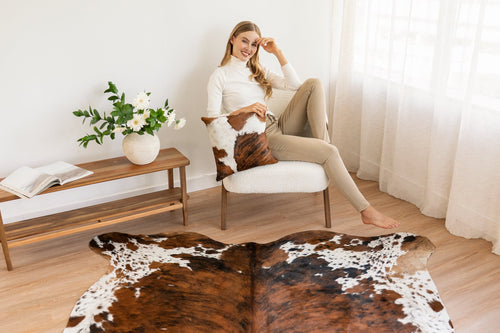
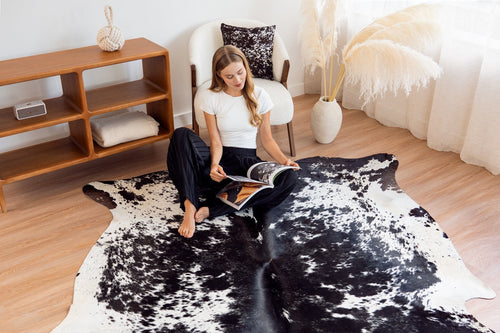
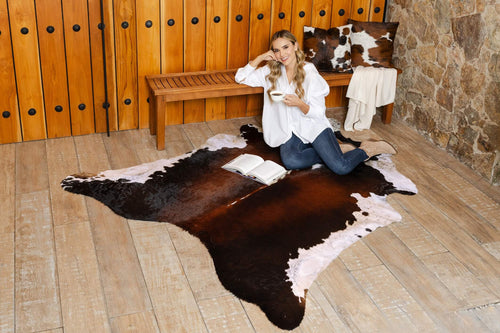
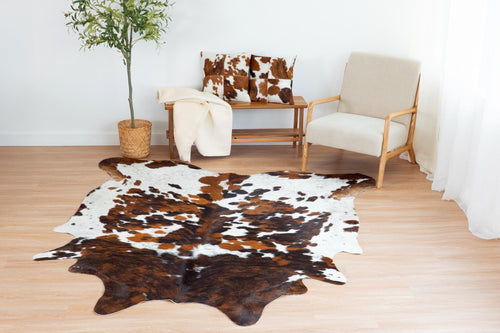
- Brindle Cowhide Rugs — the top choice for pet homes. The streaked multi-tonal pattern of dark brown, tan, and grey is the most forgiving of any natural hide pattern for everyday wear and light debris. Hair, dust, and minor marks simply don't read against brindle the way they do on lighter or more solid patterns. In a house with a dog that sheds, brindle stays looking clean between weekly shake-outs.
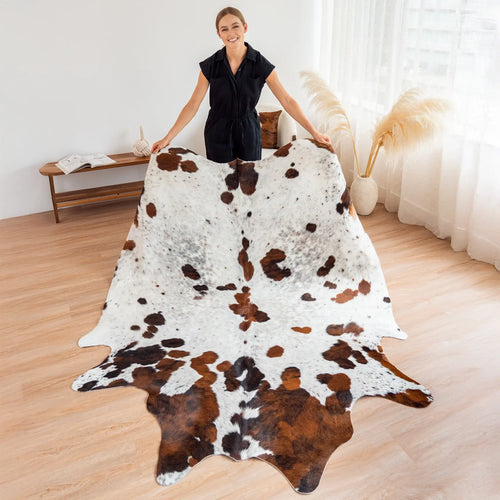
- Tricolor Cowhide Rugs — the warm three-tone spotted pattern (dark brown, caramel, ivory) is nearly as forgiving as brindle. The combination of dark and mid tones handles most of what pets contribute to daily floor life without showing it.
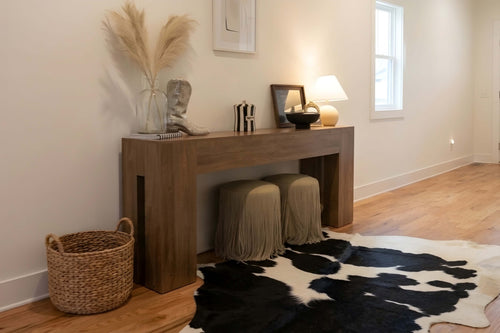
- Chocolate and White Cowhide Rugs and Brown and White Cowhide Rugs — the darker coloring handles pet life well, though the white patches will show dirt and light-colored pet hair more visibly than brindle or tricolor. Still dramatically better than any fiber alternative — just requiring slightly more frequent attention in the lighter areas.
Use with care in active pet households:
- White Cowhide Rugs and Champagne Cowhide Rugs — stunning in lower-traffic rooms or in homes with small or light-colored pets. In a house with a muddy large-breed dog, the light surface will show everyday wear between cleanings more visibly than darker patterns. Still structurally superior to any fiber alternative — but the visual maintenance demands are higher.
|
Pattern |
Pet Hair Visibility |
Everyday Wear Forgiveness |
Best For |
|
Minimal — tonal complexity hides it |
Highest |
Any pet household, any breed |
|
|
Low — multi-tone pattern absorbs visually |
High |
Any pet household |
|
|
Low on dark patches, moderate on white |
High |
Most pet households |
|
|
Variable — light hair shows on black |
Medium |
Lower-traffic rooms, darker-coated pets |
|
|
High — shows everything on light surface |
Lower |
Light-colored pets, low-traffic rooms |
Safety, Allergens & Air Quality: What Pet Owners Need to Know

For households where pet allergies are a concern — for human family members — the floor covering choice has real health implications. This is where the cowhide advantage is most significant and most underdiscussed.
Pet dander and the non-porous surface. Pet dander — the actual allergen trigger, not pet hair — is microscopic shed skin cells that attach to fiber and accumulate at depth. In a fiber rug, dander embeds in the pile structure where regular vacuuming can't reach it. It releases back into the air when the rug is disturbed — walked on, vacuumed, sat near. In a household with allergy-sensitive members, a fiber rug in a shared living area is a continuous allergen source.
The non-porous hair-on-hide surface of a genuine cowhide doesn't provide the embedded environment dander needs to accumulate. Dander that lands on the surface doesn't penetrate — it stays accessible and is removed with regular cleaning. The Allergy-Free Cowhide page covers the full clinical picture.
Is cowhide safe for pets? Yes — fully. The tanned leather backing and natural hair surface contain no toxic compounds for pets. eCowhides' production partners meet Leather Working Group (LWG) standards, which include chemical compliance at the tannery level. No VOCs, no harmful off-gassing. A pet that chews on the edge of a cowhide is not in danger — though it's not ideal for the rug.
No odor retention. Unlike fiber rugs that develop persistent pet odors over time as organic material bonds to fiber at depth, cowhide doesn't hold odor. The non-porous surface doesn't provide the bonding environment that makes pet odor structural in fiber rugs. A cowhide in a pet household smells like a home, not like pets.
"For clients with pet allergies, I stopped recommending fiber rugs in main living areas years ago. The allergen load from a fiber rug with pets is simply too high. Cowhide is the recommendation that solves the problem structurally — not with more frequent cleaning, but with a surface that doesn't accumulate the problem in the first place." — Patricia Chen, Interior Designer & Wellness Space Specialist, Chicago IL
Real-Life Pet Household Care Routine: What 20 Minutes a Week Looks Like

The honest answer to the maintenance question for a cowhide in a pet household is that it's genuinely minimal — but it does require consistency. Here's the routine that keeps a cowhide looking good through everything pets contribute.
Weekly (10 minutes):
- Shake it out. Take the hide outside — or hang it over a railing — and give it a firm shake. Loose pet hair, dust, and debris fall out without any mechanical contact with the hair surface. For heavier shedders, twice weekly is better. This is the single most important maintenance step and takes about three minutes.
- Vacuum the surface lightly with a flat suction attachment on low power, moving in the direction the hair lays. This picks up what shaking doesn't remove. Never use a beater bar or rotating brush attachment — these damage the hair follicles over time. Five minutes.
As needed (2–5 minutes per incident):
- Pet hair between cleanings: A rubber brush, a slightly damp hand run against the hair direction, or a lint roller handles surface pet hair between weekly cleanings. Two minutes.
- Spills and accidents: Blot immediately with a clean dry cloth — press and lift, don't rub. Reposition the cloth and repeat. For anything that leaves residue, a barely damp cloth with a small amount of pH-neutral dish soap, working in the direction the hair lays. Let air dry. Three to five minutes if you catch it immediately.
- Muddy paws: Wait for the mud to dry completely, then brush off dry debris before any damp cleaning. Two minutes after it dries.
Monthly (5 minutes):
- Rotate the hide 180 degrees to distribute any uneven wear from directional foot traffic or your pet's preferred sleeping spot.
- Inspect the backing briefly — check that the hide is laying flat and that no areas are taking concentrated pressure from furniture legs or a pet's repeated sleeping position.
Total: approximately 15–20 minutes per week, with incident cleanups adding a few minutes as needed. Compare that to the professional cleaning appointments, stain treatments, and eventual replacement cycles that fiber rugs in pet households generate. The Cowhide Durability Guide documents what 20+ year ownership looks like in practice — including in active households.
FAQ: Pet Owners Edition

Are Cowhide Rugs Good For Homes With Dogs?
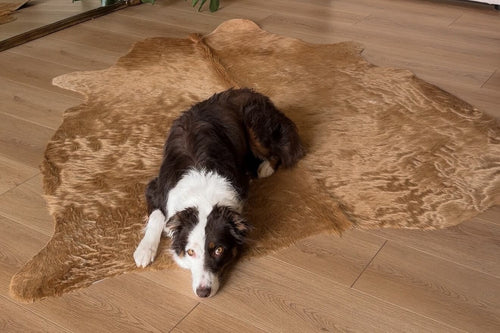
Yes — they're one of the best floor covering choices for dog households. The non-porous hair-on-hide surface resists spills and accidents, pet hair doesn't embed and brushes off easily, and the surface doesn't trap dander or odors the way fiber rugs do. For the best pattern for high-traffic dog households, Brindle Cowhide Rugs and Tricolor Cowhide Rugs are the most forgiving of everyday pet activity.
Do Cowhide Rugs Hold Pet Odors?
No — the non-porous surface doesn't provide the bonding environment that makes pet odor structural in fiber rugs. Accidents cleaned promptly don't leave lasting odor. A cowhide in an active pet household doesn't develop the persistent "pet smell" that fiber rugs accumulate over time.
Are Cowhide Rugs Safe For Pets?
Yes — fully. The tanned leather backing and natural hair surface contain no toxic compounds harmful to pets. eCowhides' production partners meet Leather Working Group (LWG) standards including chemical compliance. No VOC off-gassing, no harmful treatments. The Allergy-Free Cowhide page covers the full safety picture.
What Is The Best Cowhide Pattern For Pet Households?
Brindle Cowhide Rugs are the top recommendation — the streaked multi-tonal pattern is the most forgiving of any natural hide for everyday pet household life. Tricolor Cowhide Rugs are a close second. Both handle pet hair, light debris, and everyday wear without showing it visually between cleanings.
How Do I Remove Pet Hair From A Cowhide Rug?
Pet hair on a cowhide sits on the surface and doesn't embed. A firm shake, a flat vacuum attachment on low suction, a rubber brush, or even a slightly damp hand run against the hair direction all work effectively. Most pet hair comes off in under two minutes. This is significantly easier than removing embedded pet hair from pile fiber rugs.
How Do I Clean A Pet Accident From A Cowhide Rug?
Act immediately — blot with a clean dry cloth, pressing firmly and lifting without rubbing. Work from the outside of the spill inward. For residual odor, a solution of equal parts water and white vinegar on a barely damp cloth neutralizes effectively. Let air dry completely. If you catch it quickly, the non-porous surface prevents penetration and there's no lasting stain or odor. Full instructions are in the eCowhides Cleaning and Care Guide.
Are Cowhide Rugs Hypoallergenic For Pet Allergy Sufferers?
Yes — the non-porous surface doesn't embed pet dander the way fiber rugs do. Dander that lands on the surface stays accessible and is removed with regular cleaning rather than accumulating at depth. For households with pet-allergy-sensitive members, cowhide is a meaningful improvement over any fiber rug in the same space. The Allergy-Free Cowhide page documents the full clinical distinction.
Will My Dog Or Cat Scratch Or Damage A Cowhide Rug?
Light scratching from normal pet movement doesn't damage genuine cowhide — the dense hair-on-hide surface is more resistant to abrasion than pile fiber rugs. Sustained deliberate scratching from a large dog trying to create a nest, or a cat using it as a scratching post, can affect the hair surface over time. Redirecting those behaviors protects any floor covering, not just cowhide.
How Long Does A Cowhide Rug Last In A Pet Household?
With basic care — weekly shake-outs, prompt accident cleanup, occasional spot cleaning — a quality cowhide lasts 20+ years even in active pet households. That's three to five times longer than most fiber rugs in equivalent conditions, without the professional cleaning appointments and replacement cycles fiber rugs generate. The Cowhide Durability Guide makes the full longevity case.
What Size Cowhide Rug Works Best In A Living Room With Pets?
Large enough that the front legs of all major seating pieces sit on the hide — this creates a unified seating area and means the rug is anchored by furniture weight rather than moving around under pet activity. A non-slip pad underneath adds additional stability on hardwood or tile. Emily Henderson's Rug Size Guide covers sizing logic for every room format.
The Last Rug You'll Buy for a Room Your Pets Live In

Pet owners have replaced enough rugs to know what the fiber rug cycle looks like. The purchase, the initial optimism, the first accident that doesn't fully clean up, the hair that accumulates in the pile, the odor that develops over months, the replacement. And then the whole cycle again.
A genuine cowhide breaks that cycle. Not because pets can't affect it — they can — but because the surface doesn't hold what they contribute. Hair brushes off. Accidents clean up. Odors don't accumulate. And 20 years from now, the hide looks better than it did on arrival, not worse.
Browse Brindle Cowhide Rugs, Tricolor Cowhide Rugs, and the full collection of Natural Hide Rugs at eCowhides.com. Find the one your household — pets included — can finally keep.